Faut-il débrancher l'ethnomusicologie ?
À propos de Jean-Loup Amselle, L’Occident connaît la musique. Musiques du monde et ethnomusicologie, Sesto San Giovanni, Mimésis, 2024 (« Anthropologie » 8).
Avant-goût
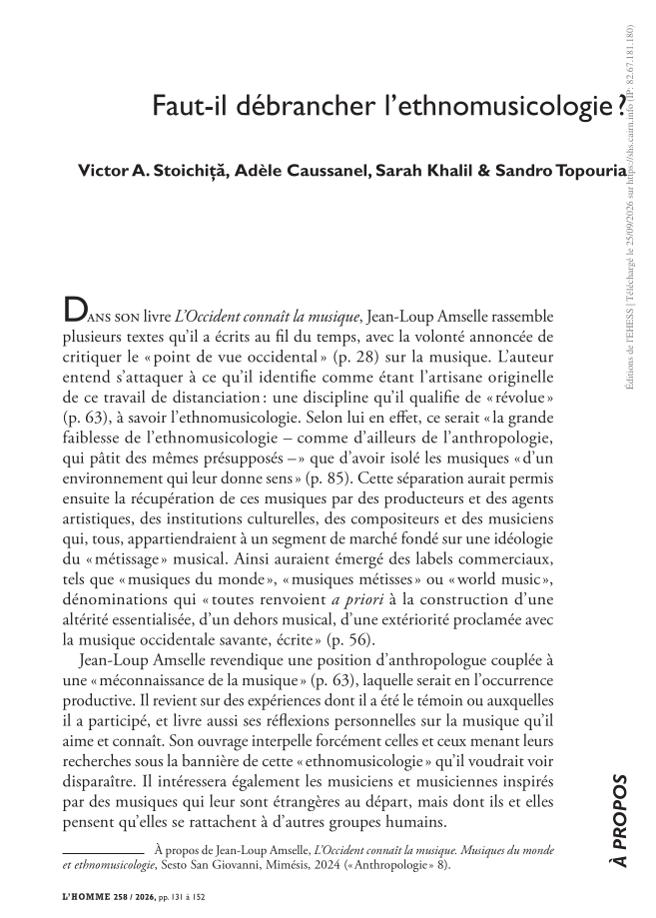
Dans son livre L’Occident connaît la musique, Jean-Loup Amselle rassemble plusieurs textes qu’il a écrits au fil du temps, avec la volonté annoncée de critiquer le « point de vue occidental » (p. 28) sur la musique. L’auteur entend s’attaquer à ce qu’il identifie comme étant l’artisane originelle de ce travail de distanciation : une discipline qu’il qualifie de « révolue » (p. 63), à savoir l’ethnomusicologie. Selon lui en effet, ce serait « la grande faiblesse de l’ethnomusicologie – comme d’ailleurs de l’anthropologie, qui pâtit des mêmes présupposés – » que d’avoir isolé les musiques « d’un environnement qui leur donne sens » (p. 85). Cette séparation aurait permis ensuite la récupération de ces musiques par des producteurs et des agents artistiques, des institutions culturelles, des compositeurs et des musiciens qui, tous, appartiendraient à un segment de marché fondé sur une idéologie du « métissage » musical. Ainsi auraient émergé des labels commerciaux, tels que « musiques du monde », « musiques métisses » ou « world music », dénominations qui « toutes renvoient a priori à la construction d’une altérité essentialisée, d’un dehors musical, d’une extériorité proclamée avec la musique occidentale savante, écrite » (p. 56).
Jean-Loup Amselle revendique une position d’anthropologue couplée à une « méconnaissance de la musique » (p. 63), laquelle serait en l’occurrence productive. Il revient sur des expériences dont il a été le témoin ou auxquelles il a participé, et livre aussi ses réflexions personnelles sur la musique qu’il aime et connaît. Son ouvrage interpelle forcément celles et ceux menant leurs recherches sous la bannière de cette « ethnomusicologie » qu’il voudrait voir disparaître. Il intéressera également les musiciens et musiciennes inspirés par des musiques qui leur sont étrangères au départ, mais dont ils et elles pensent qu’elles se rattachent à d’autres groupes humains.
[…] fallait-il répondre à un livre présenté comme étant un pamphlet, plutôt qu’une analyse précise (et qui de fait, on le verra, ne s’encombre pas d’une grande rigueur d’écriture) ? Fallait-il prendre la défense d’un domaine de recherche que nous connaissons et pratiquons, mais qui est à ce point différent de celui que l’auteur critique ? Probablement pas. D’un autre côté, l’ouvrage soulève des questions légitimes. Celles-ci ne sont guère nouvelles pour les ethnomusicologues, mais un regard extérieur invite toujours au décentrement. D’ailleurs, vingt-deux ans après la publication du numéro thématique Musique et anthropologie par la revue L’Homme (Lortat-Jacob & Rovsing Olsen 2004), l’ethnomusicologie doit-elle encore faire discipline à part ?