BEGIN:VCALENDAR
VERSION:2.0
PRODID:-//jEvents 2.0 for Joomla//EN
CALSCALE:GREGORIAN
METHOD:PUBLISH
BEGIN:VTIMEZONE
TZID:Europe/Paris
BEGIN:STANDARD
DTSTART:20191113T140000
RDATE:20200329T030000
TZOFFSETFROM:+0200
TZOFFSETTO:+0100
TZNAME:Europe/Paris CET
END:STANDARD
BEGIN:STANDARD
DTSTART:20201025T020000
RDATE:20210328T030000
TZOFFSETFROM:+0200
TZOFFSETTO:+0100
TZNAME:Europe/Paris CET
END:STANDARD
BEGIN:STANDARD
DTSTART:20211031T020000
RDATE:20220327T030000
TZOFFSETFROM:+0200
TZOFFSETTO:+0100
TZNAME:Europe/Paris CET
END:STANDARD
BEGIN:STANDARD
DTSTART:20221030T020000
RDATE:20230326T030000
TZOFFSETFROM:+0200
TZOFFSETTO:+0100
TZNAME:Europe/Paris CET
END:STANDARD
BEGIN:STANDARD
DTSTART:20231029T020000
RDATE:20240331T030000
TZOFFSETFROM:+0200
TZOFFSETTO:+0100
TZNAME:Europe/Paris CET
END:STANDARD
BEGIN:STANDARD
DTSTART:20241027T020000
RDATE:20250330T030000
TZOFFSETFROM:+0200
TZOFFSETTO:+0100
TZNAME:Europe/Paris CET
END:STANDARD
BEGIN:STANDARD
DTSTART:20251026T020000
RDATE:20260329T030000
TZOFFSETFROM:+0200
TZOFFSETTO:+0100
TZNAME:Europe/Paris CET
END:STANDARD
BEGIN:STANDARD
DTSTART:20261025T020000
RDATE:20270328T030000
TZOFFSETFROM:+0200
TZOFFSETTO:+0100
TZNAME:Europe/Paris CET
END:STANDARD
BEGIN:STANDARD
DTSTART:20271031T020000
RDATE:20280326T030000
TZOFFSETFROM:+0200
TZOFFSETTO:+0100
TZNAME:Europe/Paris CET
END:STANDARD
BEGIN:DAYLIGHT
DTSTART:20200329T030000
RDATE:20201025T020000
TZOFFSETFROM:+0100
TZOFFSETTO:+0200
TZNAME:Europe/Paris CEST
END:DAYLIGHT
BEGIN:DAYLIGHT
DTSTART:20210328T030000
RDATE:20211031T020000
TZOFFSETFROM:+0100
TZOFFSETTO:+0200
TZNAME:Europe/Paris CEST
END:DAYLIGHT
BEGIN:DAYLIGHT
DTSTART:20220327T030000
RDATE:20221030T020000
TZOFFSETFROM:+0100
TZOFFSETTO:+0200
TZNAME:Europe/Paris CEST
END:DAYLIGHT
BEGIN:DAYLIGHT
DTSTART:20230326T030000
RDATE:20231029T020000
TZOFFSETFROM:+0100
TZOFFSETTO:+0200
TZNAME:Europe/Paris CEST
END:DAYLIGHT
BEGIN:DAYLIGHT
DTSTART:20240331T030000
RDATE:20241027T020000
TZOFFSETFROM:+0100
TZOFFSETTO:+0200
TZNAME:Europe/Paris CEST
END:DAYLIGHT
BEGIN:DAYLIGHT
DTSTART:20250330T030000
RDATE:20251026T020000
TZOFFSETFROM:+0100
TZOFFSETTO:+0200
TZNAME:Europe/Paris CEST
END:DAYLIGHT
BEGIN:DAYLIGHT
DTSTART:20260329T030000
RDATE:20261025T020000
TZOFFSETFROM:+0100
TZOFFSETTO:+0200
TZNAME:Europe/Paris CEST
END:DAYLIGHT
BEGIN:DAYLIGHT
DTSTART:20270328T030000
RDATE:20271031T020000
TZOFFSETFROM:+0100
TZOFFSETTO:+0200
TZNAME:Europe/Paris CEST
END:DAYLIGHT
END:VTIMEZONE
BEGIN:VEVENT
UID:9dcac7299306f09c28c87d6d00705373
CATEGORIES:Séminaire de l'EREA, EREA
CREATED:20200903T113959
SUMMARY:Maya lords in Israel: Biblical temporality in postclassic Maya migration stories, Sergio Romero (Associate Professor, University of Texas at Austin)
DESCRIPTION:
In this presenta
tion I consider Old Testament narratives in the first títulos written in K’
iche’ in the mid-sixteenth century and in the earliest K’iche’ homiletic pr
oduction. Responding to the need to legitimize their rule and hereditary pr
ivileges, on the one hand, and to cast themselves as Christian subjects of
the Spanish king, on the other, K’iche’ noble scribes presented their ances
tors as members of one of the ancient tribes of Israel. They reinterpreted
Old Testament narratives as variations of migration stories, the emblematic
postclassic Maya official lineage history. I examine the articulation of M
aya and Christian temporalities in these texts, the fraught dialogue betwee
n Maya lords and Dominicans, and the solutions Maya nobles developed to mak
e Christian time scales and cycles compatible with Maya conceptions of time
and elite political agendas.
L'intervention sera réalisée en espagno
l.
Discutant : Mario H. Ruz (UNAM, Méxique).
Illustration : Folio 101 verso de la Theologia In
dorum du frère Domingo de Vico, 15552-1554 (American Philosophica
l Society).
Visioconférence disponible sur la chaîne Erea de Can
al U.
X-ALT-DESC;FMTTYPE=text/html: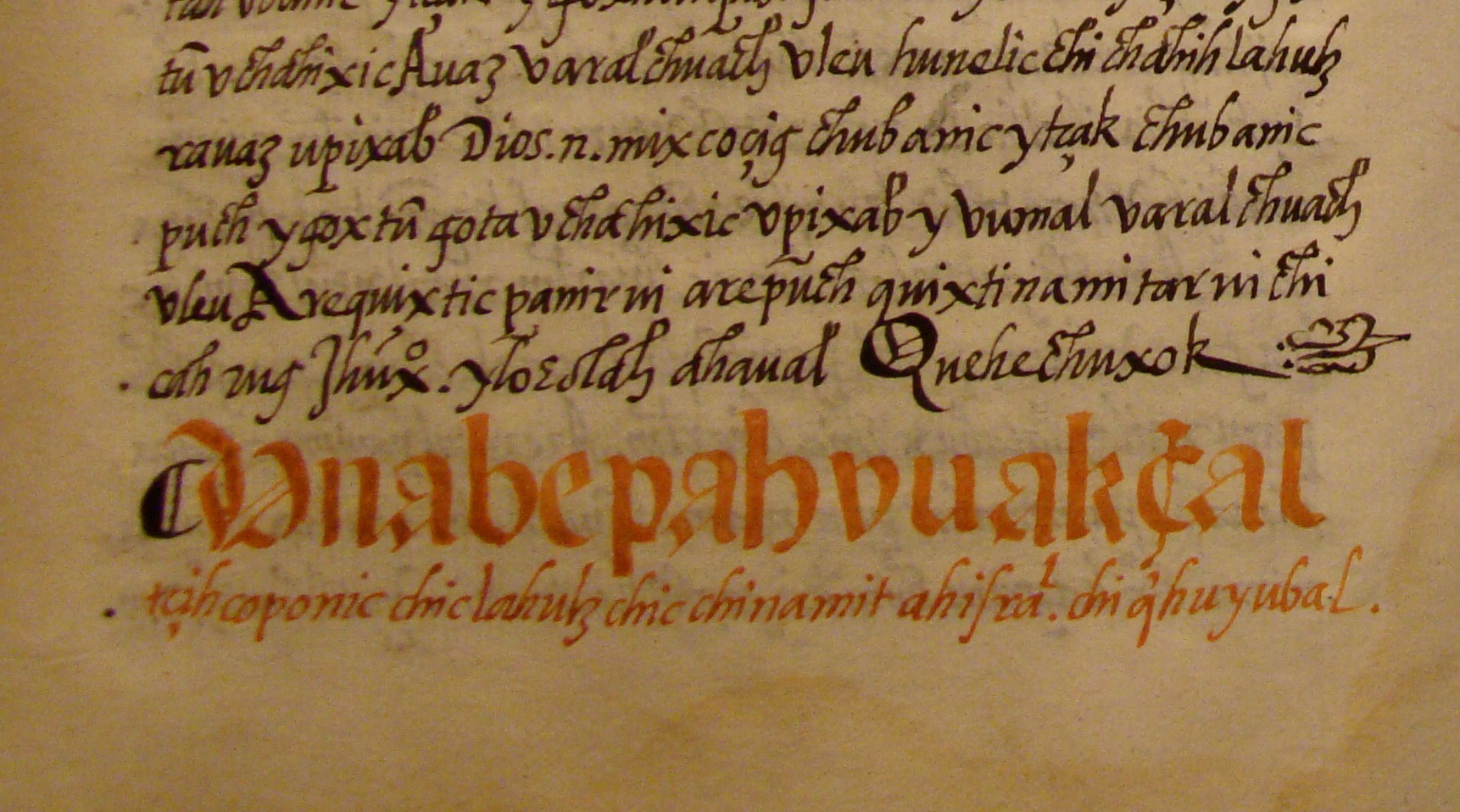
In this presentation I consider Old Testament narratives in the f
irst títulos written in K’iche’ in the mid-sixteenth century and in the ear
liest K’iche’ homiletic production. Responding to the need to legitimize th
eir rule and hereditary privileges, on the one hand, and to cast themselves
as Christian subjects of the Spanish king, on the other, K’iche’ noble scr
ibes presented their ancestors as members of one of the ancient tribes of I
srael. They reinterpreted Old Testament narratives as variations of migrati
on stories, the emblematic postclassic Maya official lineage history. I exa
mine the articulation of Maya and Christian temporalities in these texts, t
he fraught dialogue between Maya lords and Dominicans, and the solutions Ma
ya nobles developed to make Christian time scales and cycles compatible wit
h Maya conceptions of time and elite political agendas.
L'interventio
n sera réalisée en espagnol.
Discutant : Mario
H. Ruz (UNAM, Méxique).
Illustration : Folio 101 ve
rso de la Theologia Indorum du frère Domingo de Vico, 15552-1
554 (American Philosophical Society).
Visioconférence disponible sur
la chaîne Erea de Canal U.
DTSTAMP:20261017T160329
DTSTART;TZID=Europe/Paris:20201113T140000
DTEND;TZID=Europe/Paris:20201113T170000
SEQUENCE:0
TRANSP:OPAQUE
END:VEVENT
END:VCALENDAR