 Avec Trévor Watkins, professeur émérite à l’Université d’Édimbourg.
Avec Trévor Watkins, professeur émérite à l’Université d’Édimbourg.
I f we are to advance our understanding of prehistory we need to fit our arch aeological knowledge into an understandingof the (cultural) evolutionary pr ocess. That was what I was attempting with my recent book, Becomin g Neolithic, whose synthesis was framed in the context of cultural nic he construction theory. Writing prehistory is very different from the writi ng of history. As 2025 is the centenary of Gordon Childe’s first major publ ication, and of the Abercromby Chair of Archaeology at the University of Ed inburgh, to which he was appointed, it is appropriate to start by discussin g how he reframed the writing of prehistory, and how popular and influentia l were his books and ideas (in particular, the Neolithic and urban revoluti ons. In the 1960s American archaeologist-anthropologists Lewis Binford and Kent Flannery and their colleagues (under the banner of “processualist” arc haeology) attempted to update the writing of prehistory within the contempo rary framework of evolution and eco-systems theory. Since then, evolutionar y theory has been further transformed (the extended evolutionary synthesis) including the development of new fields, like (cultural) niche constructio n theory. At the same time systems theory has grown with new theoretical wo rk on complexity and complex adaptive systems theory. These theoretical adv ances are challenging archaeologists, both researchers, and teachers, and s tudents.
X-ALT-DESC;FMTTYPE=text/html: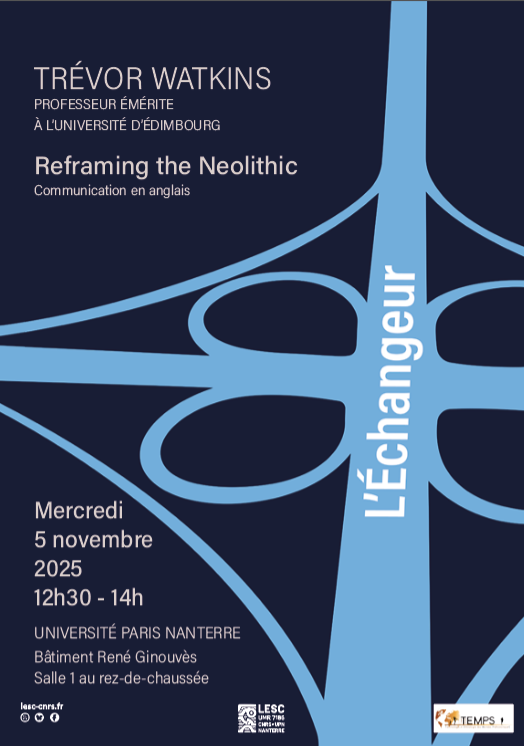 Avec Trévor Watkins, professeur émérite à l’Unive
rsité d’Édimbourg.
Avec Trévor Watkins, professeur émérite à l’Unive
rsité d’Édimbourg.
If we are to advance our understanding of prehisto ry we need to fit our archaeological knowledge into an understandingof the (cultural) evolutionary process. That was what I was attempting with my rec ent book, Becoming Neolithic, whose synthesis was framed in t he context of cultural niche construction theory. Writing prehistory is ver y different from the writing of history. As 2025 is the centenary of Gordon Childe’s first major publication, and of the Abercromby Chair of Archaeolo gy at the University of Edinburgh, to which he was appointed, it is appropr iate to start by discussing how he reframed the writing of prehistory, and how popular and influential were his books and ideas (in particular, the Ne olithic and urban revolutions. In the 1960s American archaeologist-anthropo logists Lewis Binford and Kent Flannery and their colleagues (under the ban ner of “processualist” archaeology) attempted to update the writing of preh istory within the contemporary framework of evolution and eco-systems theor y. Since then, evolutionary theory has been further transformed (the extend ed evolutionary synthesis) including the development of new fields, like (c ultural) niche construction theory. At the same time systems theory has gro wn with new theoretical work on complexity and complex adaptive systems the ory. These theoretical advances are challenging archaeologists, both resear chers, and teachers, and students.
DTSTAMP:20261017T081536 DTSTART;TZID=Europe/Paris:20251105T123000 DTEND;TZID=Europe/Paris:20251105T140000 SEQUENCE:0 TRANSP:OPAQUE END:VEVENT END:VCALENDAR